
The Agent-to-Agent Handoff Problem: Why Session Trust Breaks in Multi-Agent AI Systems
The AI Security Problem Nobody Is Talking About
The AI industry spent the last two years learning how to secure individual agents.
Prompt injection.
Tool misuse.
Memory poisoning.
Excessive permissions.
These became the primary focus of enterprise AI security programs.
But as organizations move from single-agent deployments to multi-agent systems, a new problem is emerging—one that may prove even more dangerous.
The problem is not the agent.
The problem is the handoff.
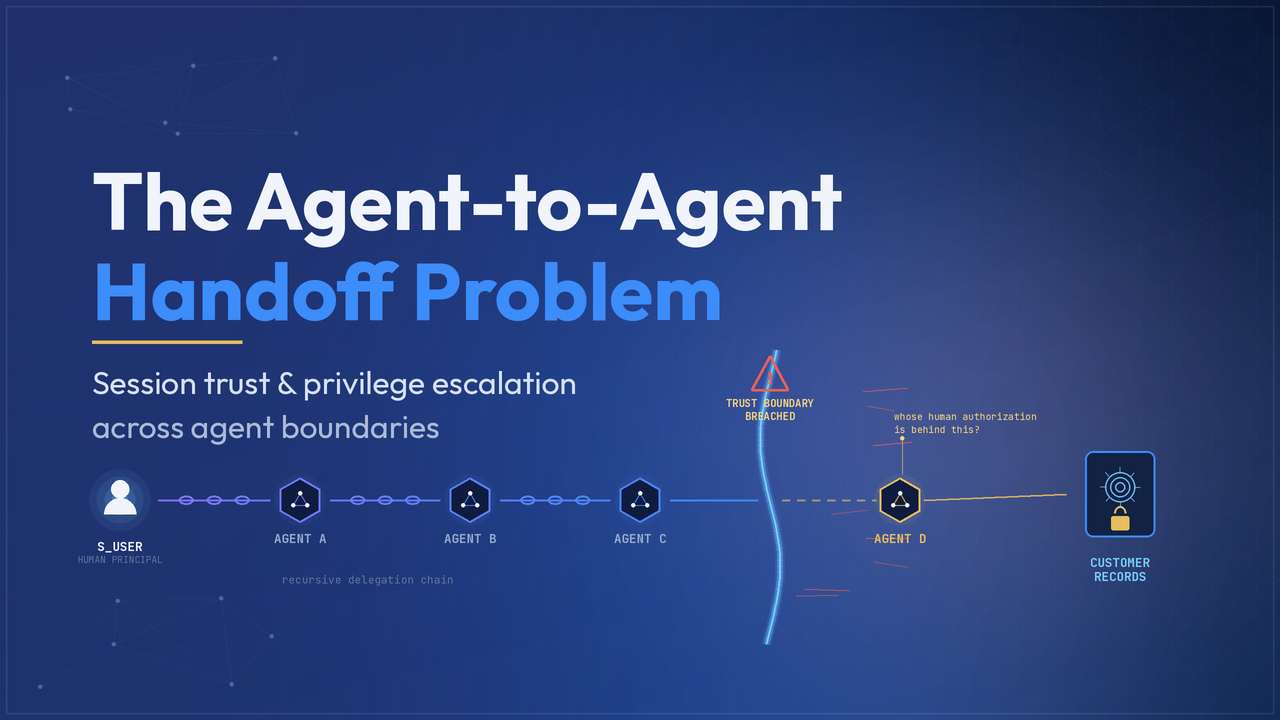
Every time one AI agent delegates work to another, a trust boundary is crossed.
And in most enterprise deployments today, that boundary is crossed without sufficient verification.
The result is a growing class of risks involving:
- Identity collapse
- Privilege escalation
- Broken attribution
- Cross-agent trust contagion
Collectively, these challenges form what can be called the Agent-to-Agent Handoff Problem.
Why Multi-Agent Systems Change Everything
A single-agent architecture is relatively straightforward.
A user interacts with one agent.
That agent performs approved actions.
Authorization remains comparatively simple.
Multi-agent systems introduce a very different model.
An agent may:
- Delegate tasks to another agent
- Invoke specialized sub-agents
- Cross organizational boundaries
- Interact with external services
Create recursive chains of delegation
A single enterprise workflow may involve dozens of autonomous handoffs.
Each handoff becomes a potential security event.
The critical question is no longer:
"What can this agent do?"
"What happens when this agent asks another agent to act?"
The Return of the Confused Deputy
Security researchers have seen this problem before.
In traditional distributed systems, it was known as the Confused Deputy Problem.
A privileged system is tricked into performing actions on behalf of a less-privileged user.
The attacker never obtains the privileged credential directly.
Instead, they abuse the trusted intermediary.
AI agents make this problem significantly more dangerous because they:
- Act autonomously
- Operate asynchronously
- Delegate recursively
Execute at machine speed
The result is privilege escalation through delegated trust rather than direct compromise.Three Questions Most Systems Cannot Answer
Imagine:
Agent A tells Agent B:
"Deploy this change to production."
Three critical questions immediately emerge:
1. Did Agent A Actually Have Authority?
Was Agent A authorized to request that action?
Or did it simply possess a credential capable of making the request?
2. Did Agent B Receive More Privilege Than It Needed?
Was authority narrowed during delegation?
Or did Agent B inherit excessive permissions?
3. Which Human Authorized the Action?
Can the organization trace the action back to the originating person?
Or did the authorization chain disappear somewhere in the delegation process?
For many enterprise systems today, the answer is:
Nobody knows.
The Three Failure Modes
Research consistently identifies three recurring breakdowns.
Identity Collapse
The most common problem occurs when agents operate under service accounts or shared machine identities.
The target system no longer sees:
- The originating user
- The original authorization
- The permission boundary
Instead, it only sees a highly privileged machine identity.
Attribution disappears.
Scope Inflation
Delegation should narrow permissions.
In practice, it often does the opposite.
Agent B frequently inherits the full access rights of Agent A.
Each handoff increases the attack surface.
Instead of least privilege, organizations accidentally create privilege amplification chains.
Trust Contagion
The most dangerous scenario emerges when trust propagates across multiple agents.
Compromise one agent.
Inherit trust from the next.
Then the next.
Then the next.
A local compromise can become a multi-system incident within seconds.
Trust becomes contagious.
Why OAuth, SAML, and OIDC Struggle
Many organizations assume existing identity frameworks solve these problems.
Unfortunately, these technologies were designed for a different world.
They assume:
- Human users
- Interactive sessions
- Single-hop delegation
- Clearly defined trust boundaries
AI agents violate all of those assumptions.
Modern agents:
- Operate continuously
- Act without active human involvement
- Delegate recursively
- Cross organizational boundaries
- Alternate between human-directed and autonomous behavior
Identity frameworks built for browsers and human sessions struggle to represent these realities effectively.
What Session Trust Must Mean in the Agent Era
Traditional trust models often stop after authentication.
Agentic systems require a deeper definition.
True session trust should answer seven questions:
Can the full delegation chain be verified?
Can every action be attributed to a specific human?
Does authority narrow on every handoff?
Is effective privilege bounded by the originating user's permissions?
Are capabilities short-lived and task-specific?
Is authorization checked continuously at runtime?
Can every handoff be audited and revoked?
Most production systems satisfy only a fraction of these requirements today.
A Blueprint for Enterprise AI Security
Organizations deploying multi-agent systems should begin adopting several architectural principles immediately.
Treat Every Agent as an Identity
Agents should never operate as anonymous service accounts.
Every agent requires:
- Unique identity
- Ownership
- Lifecycle management
- Governance controls
Enforce Authorization at the Boundary
Every handoff should become an authorization checkpoint.
The boundary not the agent should become the primary enforcement layer.
Use Short-Lived, Task-Specific Capabilities
Authority should narrow as it travels.
Delegated permissions should expire automatically.
Limit Delegation Depth
Recursive delegation should not continue indefinitely.
Organizations should define clear limits and require reauthorization beyond approved thresholds.
Audit the Entire Chain
Logging the final action is no longer sufficient.
Security teams need visibility into:
- Who initiated the task
- Which agents participated
- Which permissions were exercised
- Where authority changed
- End-to-end attribution becomes essential.
Why This Matters to CAIOs and CISOs
Many enterprises are currently focused on deploying AI agents faster.
The larger challenge is governing them safely.
As AI systems evolve from assistants into autonomous actors, identity becomes the new security perimeter.
Organizations that fail to establish strong delegation controls may discover that:
- Their audit trails are incomplete
- Their permissions are excessive
- Their agents are operating beyond intended authority
The risk is not theoretical.
It is architectural.
And it grows with every additional agent introduced into the environment.
Final Thoughts
The defining AI security challenge of 2026 may not be prompt injection.
It may not be model alignment.
It may not even be agent autonomy.
It may be something far simpler:
Can we prove who authorized an action after multiple agents have delegated work across organizational boundaries?
Today, the answer is often no.
The future of enterprise AI will depend on solving that problem.
When software begins acting like staff, it needs more than intelligence.
It needs identity.
It needs accountability.
And it needs a paper trail.
The agent-to-agent handoff is where organizations discover whether those controls actually exist.
References
Kumar, B. (2026). *The Agent-to-Agent Handoff Problem: Session Trust and Privilege Escalation Across Agent Boundaries.*
NIST NCCoE. Accelerating the Adoption of Software and AI Agent Identity and Authorization (2026).
OpenID Foundation. Identity Management for Agentic AI (2025).
RFC 8693. OAuth 2.0 Token Exchange.
OWASP Agentic Security Initiative.
Cloud Security Alliance. State of AI Cybersecurity 2026.
Additional academic references cited in the original research paper.
Author Note
This article explores identity, delegation, and authorization challenges in multi-agent AI systems. The analysis is based on current research, enterprise security practices, identity standards, and emerging frameworks for agent governance and runtime authorization.